 Karsten Silz
 Do holiday apartment hosts need terms and conditions?
Terms and conditions are not mandatory for holiday apartment hosts in Germany. A legal notice and privacy policy are. What applies without them and what to watch out for.
Short answer: No. Nobody forces you to have terms and conditions (in German: AGB).
Still, almost every host asks this question at some point. Usually when the first guest cancels shortly before arrival.
Do you really need terms and conditions for that? What happens if you have none? And what should you watch out for if you want to use your own? This article shows what you really need – and what you can skip.
Upfront, in all honesty: This is not legal advice. It is general guidance based on German law. If you have specific legal questions or want your own terms drafted, ask a lawyer. And one more thing: MeineFeWoSeite does not provide terms and conditions. More on that below.
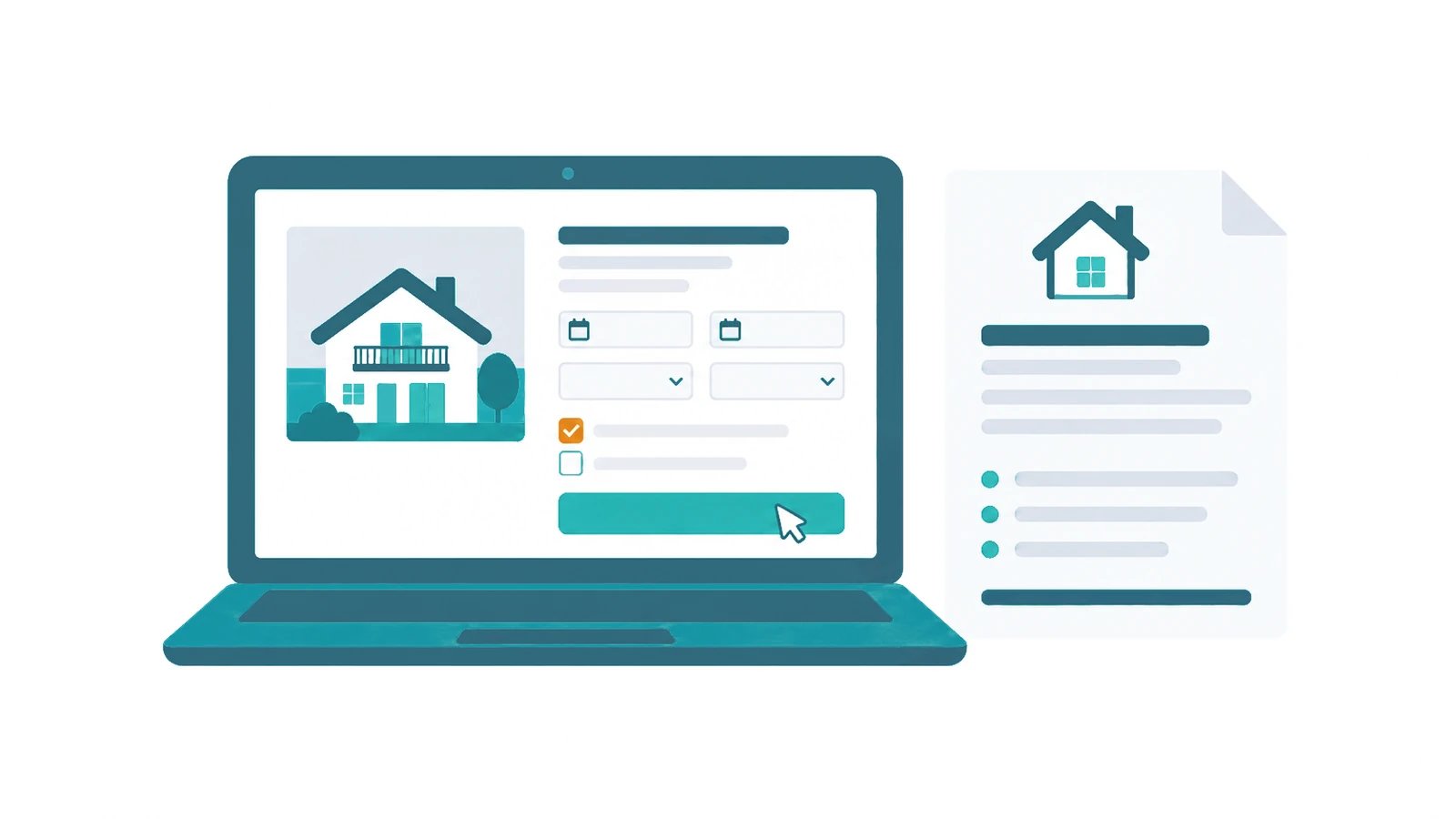
Terms and conditions are not mandatory
There is no general law that requires holiday apartment hosts to use their own standard terms and conditions.
No holiday apartment strictly needs terms and conditions.
They can still be useful. The reason is practical, not legal: they let you set recurring rules for your bookings in one consistent way – for example on cancellations, deposits, security deposits, pets or house rules.
Without terms and conditions you do not automatically have to handle these things differently. But make sure important agreements are made with the guest clearly and in good time.
Don't confuse them: legal notice and privacy policy
Terms and conditions are something different from the mandatory legal information on your website.
A website run for business purposes may in particular need a legal notice (Impressum) and privacy information. Which details are required depends, among other things, on the operator and on the services used.
This information is not terms and conditions. So when someone says "I need something legal on my website", they usually mean these two. Terms and conditions are a separate matter.
Good news for MeineFeWoSeite users
Every website you publish with MeineFeWoSeite automatically gets a legal notice page and a privacy policy – in German and in English.
Both are filled with your data when you publish: name, address and contact details. The privacy policy also names the data protection authority responsible for you, derived from your country and federal state.
You don't have to write these pages yourself. Just check that your details in the portal are correct.
What applies if you have no terms and conditions?
Then the statutory rules apply, plus whatever you agreed with the guest. That is not a gap in the contract – it is the normal starting point.
Which statutory provisions apply in detail also depends on how the specific contract is classified legally. For a classic holiday apartment rental, the tenancy rules of the German Civil Code (BGB) can play a key role. If you offer additional services, the classification may differ.
What happens when a guest cancels?
For a holiday apartment booking classified as a rental contract, Section 537 (1) BGB states that the tenant is generally not released from the obligation to pay just because they do not use the property for a reason that lies with them.
So a cancellation does not automatically mean you have no claim to payment. There are important limits, though:
- Expenses you save because the property is not used must be taken into account.
- If you rent the property to someone else for the same period, or gain a comparable benefit from using it otherwise, that must generally be taken into account too.
In other words: you cannot get paid twice for the same period.
What about the often-quoted 10%?
For holiday apartments, German case law and legal literature sometimes use savings of about 10% as a guideline.
But this is not a fixed statutory flat rate. How much you actually save depends on the specific property and its costs. So don't treat the 10% as an automatic statutory cancellation fee.
What you miss without terms and conditions
To be honest: with terms and conditions you can settle many recurring questions consistently from the start.
Without them, for example, there is no cancellation scale that applies automatically, such as "up to 30 days before arrival 20%, after that 50%". Rules like this must be agreed explicitly – and, if used as standard terms, they must also be valid in substance.
You should also agree a security deposit explicitly. You cannot simply demand one afterwards if no such agreement exists.
The same goes for practical rules such as:
- maximum occupancy
- pets
- smoking
- house rules
- arrival and departure times
- key handover
Many small hosts still manage without extensive terms and conditions. With few bookings, direct contact and clear individual agreements, that can be a perfectly legitimate choice.
Doing without terms and conditions is not an omission.
The most common misconception: the right of withdrawal
"But I have 14 days to withdraw." Hosts hear this sentence a lot. For a typical booking of holiday accommodation for a specific period, however, it is not true.
Section 312g (2) no. 9 BGB excludes contracts for accommodation for purposes other than residential purposes from the statutory right of withdrawal if a specific date or period is set for the service. This typically covers booking holiday accommodation for specific travel dates.
This means: for such a booking there is generally no statutory 14-day right of withdrawal – whether or not you use terms and conditions.
Your own cancellation terms are a separate matter. If you voluntarily give your guests a right to cancel, the conditions you have validly agreed apply.
If you want terms and conditions: the typical pitfalls
Now for the important part. Bad terms and conditions are worse than none at all. They can create a sense of security while containing clauses that are invalid.
1. The guest must be able to see the terms before the contract is concluded
Terms and conditions do not become part of the contract just because they appear somewhere on your website.
Under Section 305 (2) BGB you must point the other party to the terms when the contract is concluded and give them a reasonable opportunity to read them. The other party must also agree to them applying.
If you only send the terms after the contract is concluded – for example with the booking confirmation – that is generally not enough to make them part of the contract afterwards. In practice this is where things easily go wrong.
That's why MeineFeWoSeite takes care of this technical step for you. As soon as you have stored your own terms, your published website automatically gets a terms page at /agb – in English at /en/agb – with a link in the footer.
Your booking request form also gets a mandatory checkbox: "I agree to the terms and conditions." The term links directly to your terms page. Without ticking the box, the form cannot be sent.
This way the guest can read the terms before sending and confirm that they apply.
Important: Embedding your terms technically does not automatically make them legally valid. Whether individual clauses are permissible in substance is a separate question.
2. Surprising clauses do not apply
What is written in terms and conditions is not automatically valid.
Under Section 305c BGB, provisions do not become part of the contract if, under the circumstances – in particular the outward appearance of the contract – they are so unusual that the other party could not have expected them. Any doubts in interpreting standard terms also go against the party using them.
In short: Don't hide unusual rules in the small print.
3. Unfair clauses do not apply
Section 307 BGB sets limits on the content of standard terms. Clauses are invalid in particular if they unreasonably disadvantage the other party, contrary to good faith. A lack of clarity and comprehensibility can also make a clause invalid.
So a clause does not become valid just because it is worded in a complicated way.
4. You cannot exclude liability completely
A blanket exclusion of liability does not work.
Certain liability cannot be excluded or limited in standard terms, in particular for damage from injury to life, body or health, and for intentional or grossly negligent conduct.
Wording like "The host accepts no liability for any damage whatsoever" is therefore not a good idea legally.
5. An invalid clause is not simply replaced by a better one
An invalid clause does not automatically make the whole contract invalid.
Under Section 306 BGB the rest of the contract generally remains in force. The statutory provisions generally take the place of the invalid clause.
That is one reason why you should not simply copy terms together from different sources.
6. The cancellation scale must stay fair
Cancellation rules are among the most important points for holiday apartments – and among the most legally sensitive.
A flat-rate compensation set in standard terms must not exceed the damage expected in the ordinary course of events. The guest must also expressly keep the option to prove that no damage, or much less damage, occurred (Section 309 no. 5 BGB).
Wording like "On cancellation, 80% of the total price is always due. Proof of a lower loss is excluded." is therefore problematic.
A valid cancellation rule should fit your rental model and be legally checked.
7. The test for old templates: the ODR platform
This is where a look at old templates pays off.
The EU platform for online dispute resolution (ODR) has been shut down. The underlying EU regulation was repealed with effect from 20 July 2025. Many older templates therefore still contain a notice or link to the former ODR platform.
If you find this link in a free template, that is a clear warning sign: the template has most likely not been updated.
Checklist: what can go into holiday rental terms?
If you have terms drafted or your existing terms reviewed, these points in particular may be relevant, depending on your rental model:
- Conclusion of the contract – when is the booking binding?
- Prices and what is included
- Extra costs such as final cleaning, tourist tax or accommodation tax, bed linen and pets
- Deposit and payment deadlines
- Arrival and departure times
- Key handover
- Cancellation by the guest
- Withdrawal by the host
- Maximum number of guests
- Pets
- Smoking and house rules
- Security deposit
- Liability and duties of the guest
- Handling defects and reporting them
- Other rules relevant to your specific rental model
Not every one of these points has to be in your terms. What matters is which rules your rental model actually needs.
Where can you get support?
Lawyer or specialist lawyer
The safest option if you need individual terms tailored to your rental model. It costs money – in return you get a legal review that fits your business.
DEHOGA and the German Hotel Association (IHA)
Both associations offer information and, in some cases, templates or contract documents for the accommodation sector. Note: many of these documents are tailored to hotels or other accommodation businesses. For a single holiday apartment, you may need to adapt them.
Chambers of commerce (IHK)
The German chambers of commerce and industry provide general information on standard terms and contract drafting. This does not replace individual legal advice or a review of your own terms.
Regional tourism and host associations
These also sometimes offer templates, recommendations and information for hosts.
Free templates from the internet
Handy, but use them with care. Templates can be outdated, come from a different industry or not fit your rental model.
If you adopt a template, you remain responsible for using your terms. Even a template from an association or another provider does not guarantee that it is suitable or up to date for your case.
What MeineFeWoSeite does – and what it doesn't
Plain words first. In the portal, this notice appears directly above the terms section:
Important: no terms template and no legal advice. MeineFeWoSeite does not provide legal advice and does not provide a terms and conditions template. You create your own terms or do without them. If you do without, the statutory rules apply.
This applies in the portal just as it does to this article.
Why do we provide a legal notice and privacy policy, but no terms and conditions?
Because they are two different things.
The legal notice and privacy policy mainly contain details that can be generated in a structured way from your data and your website's features.
Terms and conditions, on the other hand, are your individual business terms: your cancellation rules. Your security deposit. Your house rules. Your pet rules. Your payment terms.
There is no single terms template that fits every host. And a template that doesn't fit your business can cause more problems than it solves.
What we do: we give you information and pointers on what to watch out for. Just like in this article. And we make sure your own rules reach your guests.
If you have your own terms and conditions
In the host portal, you'll find a terms section under "Buchungskonditionen" (booking conditions). Tick "eigene AGB" (own terms) and write your text in the Markdown editor – up to 50,000 characters.
Already have your terms as a file? Upload it as PDF, DOC, DOCX or TXT up to 5 MB. The content goes straight into the editor.
As soon as text is stored, two things happen automatically when you publish your website:
- Your website gets a terms page at
/agb, in English at/en/agb, linked in the footer. - Your booking request form gets a mandatory checkbox – in German and English. Without ticking it, the request is not sent.
If you have not stored any terms, neither the footer link nor the checkbox appears. Nothing empty is left lying around.
If you have no terms and conditions
You can still communicate your rules clearly. In the booking conditions you maintain, for example:
- Deposit
- Cancellation
- Check-in from/to
- Check-out from/to
- Key handover
- Parking
These details appear on your published website. So the guest knows before sending a request which conditions are meant to apply to the booking. That creates clarity – without extensive terms.
You get the legal notice and privacy policy anyway. They don't depend on whether you use terms and conditions.
Conclusion
- Terms and conditions are generally not mandatory for holiday apartment hosts. A legal notice and privacy policy are – and MeineFeWoSeite provides them.
- Without terms, the statutory rules apply, plus the individual agreements you have validly made with your guest.
- For a booking classified as a rental contract, a guest's cancellation can still lead to an obligation to pay. Saved expenses and benefits from renting to someone else are taken into account.
- Terms are useful if you want to set recurring rules such as cancellation, security deposit, pets or house rules consistently.
- Bad terms are worse than none. Invalid clauses don't protect you. Free templates can be outdated – a link to the EU ODR platform gives them away.
- Whatever you decide: communicate your booking and cancellation conditions openly and clearly.
And once more: this article is not legal advice but general guidance. If you need binding terms and conditions, have them legally reviewed for your rental model.
MeineFeWoSeite brings your website, booking conditions and booking requests together – with or without your own terms and conditions.